Q6. Look at the measurement of vernier calipers:
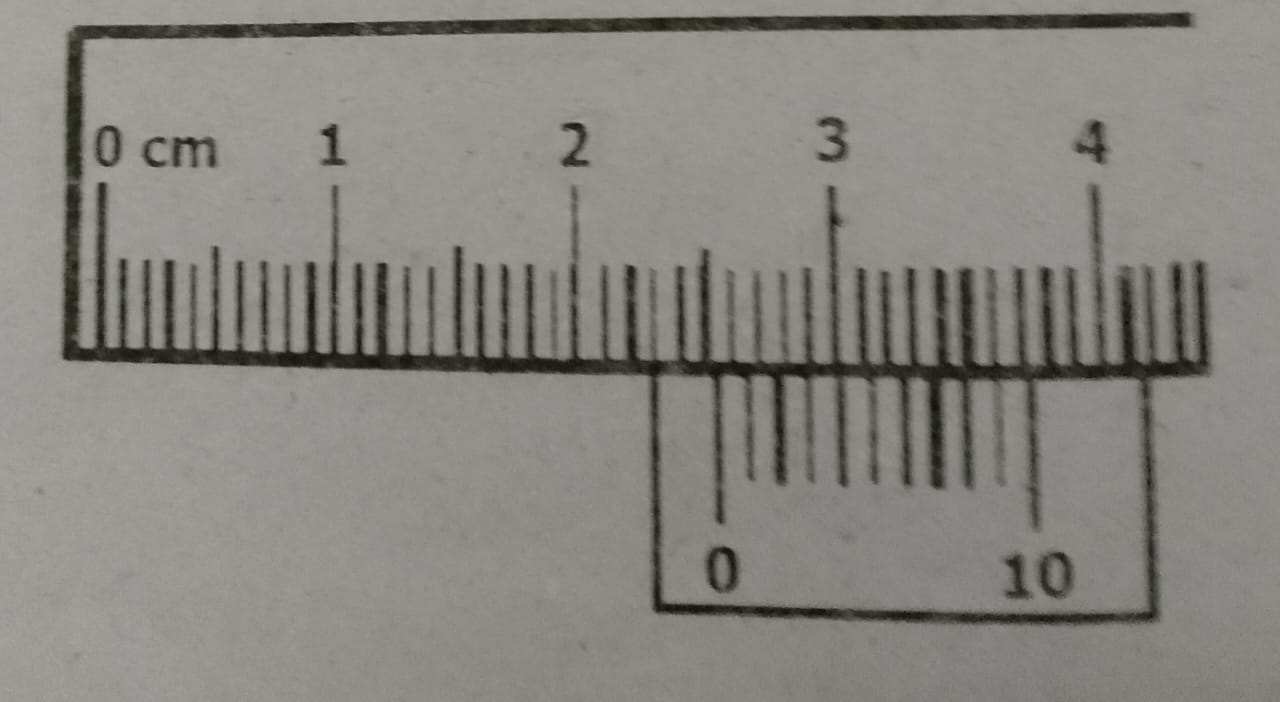
Look at the measurement of vernier calipers:             a. What is its main scale reading? b. What is its coinciding division on the vernier scale? Calculate the total reading on the vernier calipers. Ans: a. The main scale reading (reading to which zero of vernier scale coincides) is 2.5 cm. … Read more

Q5. What is pitch and least count of: a. Vernier calipers if the smallest division on the main scale is 1 mm and total divisions on the vernier scale are 20. b. Screw gauge if the smallest division on its main scale is 0.5 mm and its movable scale has 50 divisions.

What is pitch and least count of: a. Vernier calipers if the smallest division on the main scale is 1 mm and total divisions on the vernier scale are 20. b. Screw gauge if the smallest division on its main scale is 0.5 mm and its movable scale has 50 divisions. Ans: a. The least … Read more

Q2. List with brief descriptions of different branches of physics.

Ans: Due to the vast scope and research in physics, it is usually divided into several branches some of them given below: Mechanics: Description: Motion of objects and how it relates to forces. Examples: falling objects, friction, weight, spinning objects Heat and Thermodynamics: Description: Heat and temperature their related to energy. Examples: melting and freezing … Read more

Q.1 Define Physics. Describe its revolutionary role in technology.

Ans: Physics: ‘Physics can be defined as the study of matter and energy’. Physics and Technology: Rockets and space shuttles, magnetically levitating trains, and microscopic robots that fight cancer cells in our bodies. All of these technologies, whether ordinary or exciting, are based on the principles of physics. Physics is behind every technology and plays … Read more

Q12. Differentiate between precision and accuracy.

Ans: Differentiate between precision and accuracy. Precision Accuracy (i) Precision refers to the degree of consistency or reproducibility of measurements. (i) Accuracy refers to the degree of closeness between a measured value and the true or accepted value. (ii) A measurement is precise if repeated measurements under the same conditions yield similar results, regardless of … Read more

Q11. How random error can be reduced?

Ans: Random errors are unpredictable and uncontrollable errors that can happen irregularly. These errors can be caused by fluctuations in experimental conditions or imperfections in measuring instruments. Random errors can be reduced by increasing the number of measurements and using more precise measuring instruments. To minimize random errors, it is important to take repeated measurements … Read more